The subscription software model is facing a structural shift. For the past two decades, Software-as-a-Service (SaaS) was the gold standard for business efficiency. Organizations willingly paid recurring monthly fees for tools that organized data, tracked pipelines, and streamlined communication.
But traditional SaaS has a fundamental flaw: it requires human labor to operate it.
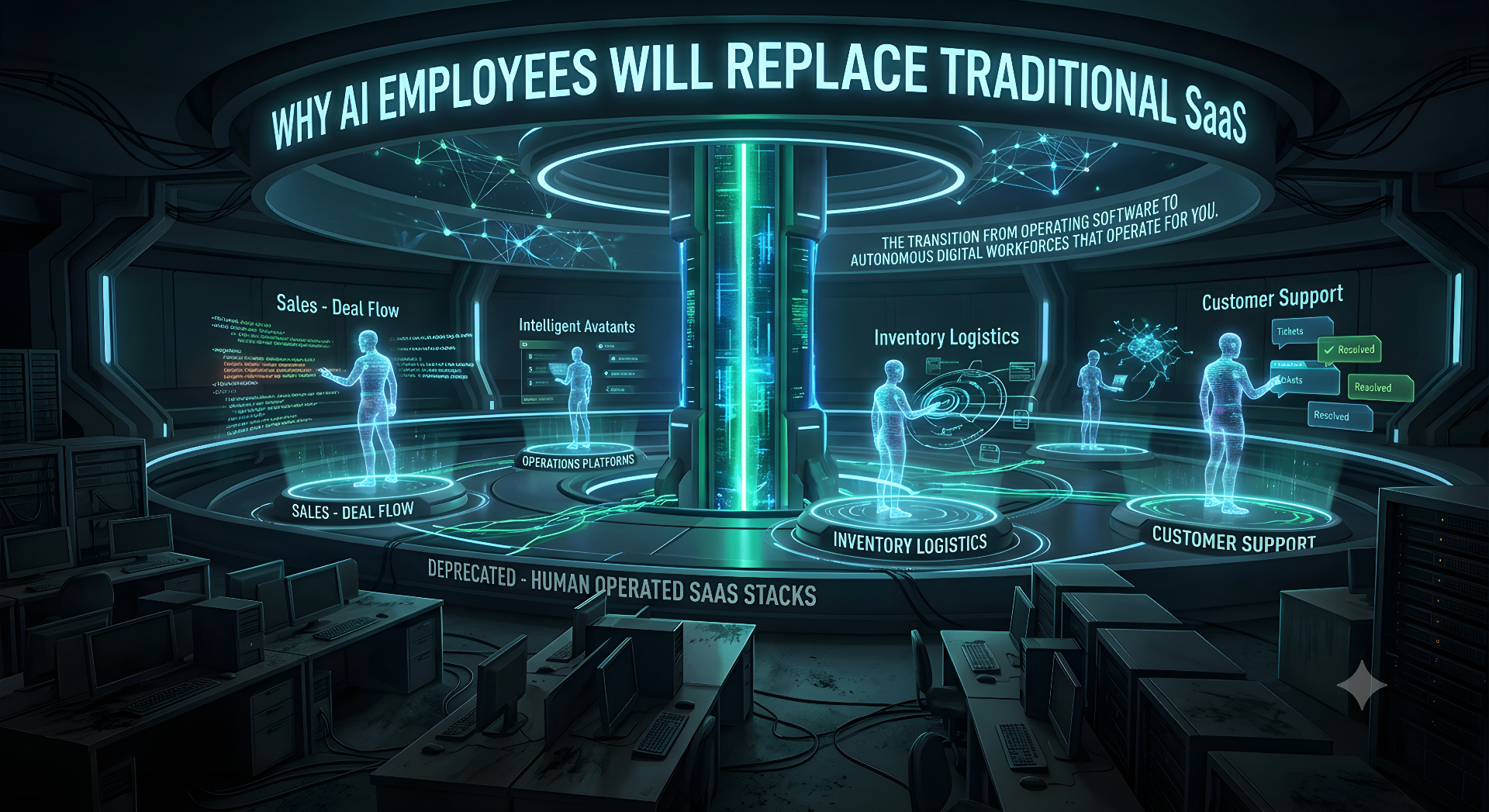
As artificial intelligence shifts from a generative novelty into infrastructure-level orchestration, the software paradigm is evolving from tools that help humans work, to autonomous digital employees that do the work themselves. The era of traditional SaaS is ending, and the era of the digital workforce has begun.
The Core Problem: The Burden of the Software Stack
Traditional SaaS platforms are passive systems. A CRM does not close a deal; an email marketing tool does not handle a complex customer objection; a scheduling app does not negotiate a calendar conflict. They are empty digital filing cabinets.
Consequently, businesses are forced to scale their overhead to manage their software. Human employees spend an estimated 30% to 40% of their workdays acting as "middleware"—performing the manual glue work of copy-pasting data, routing tickets, and triggering automations between siloed applications. Businesses are over-software'd and under-executed.
AI Employees Shift the Unit of Value
AI employees completely invert this dynamic. When an organization deploys a digital worker, they are no longer purchasing a software license; they are acquiring operational capacity.
- From Input to Outcome: With traditional SaaS, you pay for user seats and input the labor yourself. With an AI employee, you pay for the automated execution of an entire role—such as an always-on customer support representative, a speed-to-lead triage agent, or a backend operations manager.
- Zero Integration Friction: Instead of managing complex API webhooks to make ten different tools talk to one another, an infrastructure-level AI operating system centralizes communication, knowledge networks, and decision-making into a single environment.
- Infinite, Linear Scalability: A traditional software stack breaks under spikes in volume, requiring more human hiring to handle the load. An AI digital workforce scales from 3 to 30 to 300 active workers instantly, operating 24/7/365 with perfect data continuity and zero performance degradation.
The Infrastructure Reality
The transition from point-solution SaaS tools to autonomous digital workforces requires a fundamental architectural change. It cannot be achieved by slapping an AI wrapper on top of an old database. It requires a unified infrastructure layer—a neural operating system capable of coordinating data, workflows, and decisions simultaneously.
The companies that thrive in the next decade will not be those that build better software tools for humans to click. They will be the ones that build the infrastructure allowing businesses to deploy, govern, and scale autonomous intelligence.